

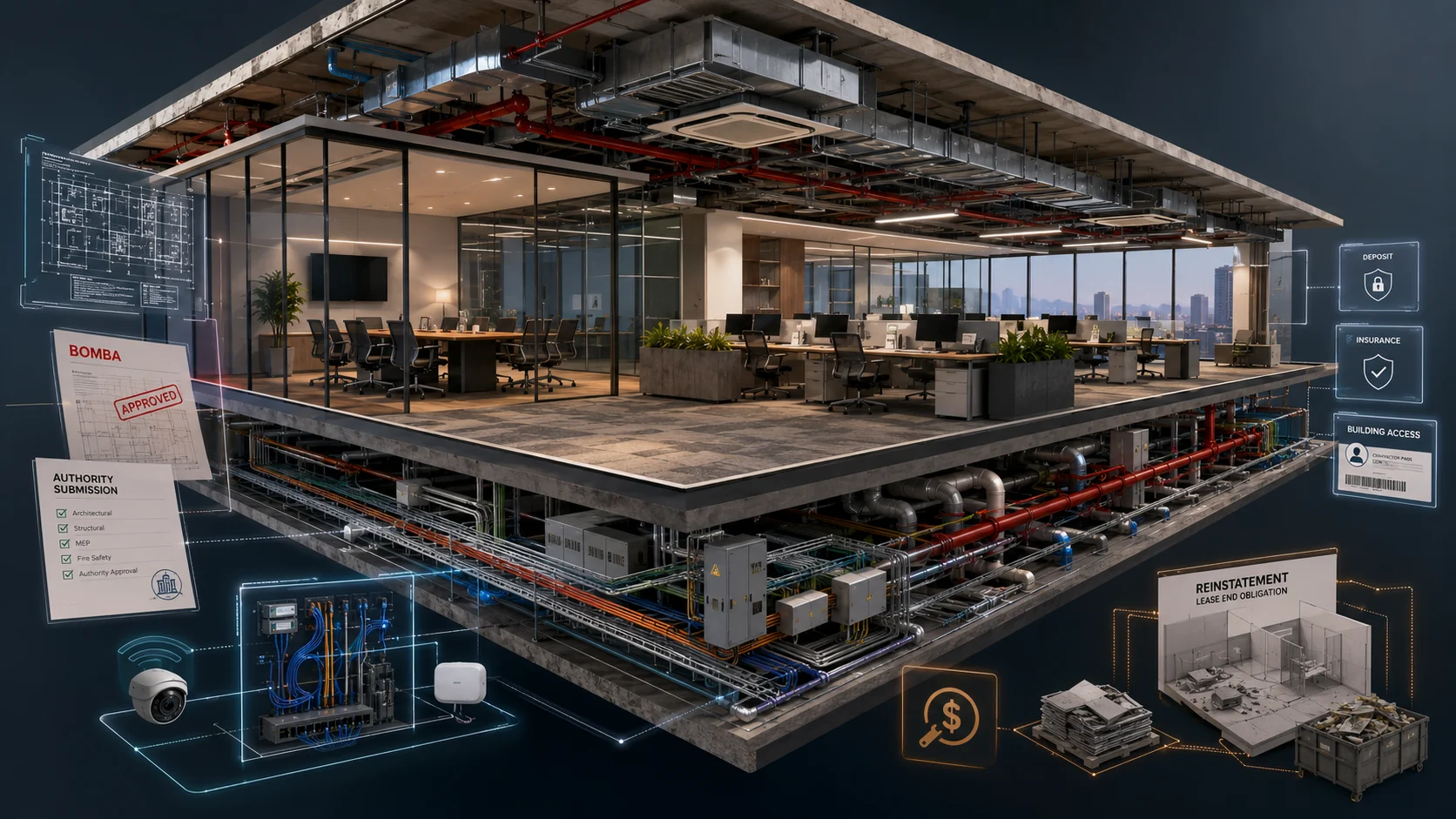

What business owners, office tenants, and decision-makers need to know before the first contractor walks through the door.
The hidden costs of office renovation in Malaysia usually do not appear in the first design proposal. Many businesses start with a baseline quotation and assume that is the full budget, only to face additional costs once the project moves onsite, from M&E adjustments and building management requirements to IT cabling, furniture, delays, and reinstatement obligations.
At Hartamas Design Associates, we help businesses plan, design, and deliver office renovation and fit-out projects across Klang Valley. This article breaks down eight hidden renovation costs Malaysian businesses should understand upfront, so decision-makers can budget more realistically, ask better questions, and avoid surprises once work begins.
— The 8 Hidden Costs at a Glance
- M&E works (air-conditioning, electrical, fire) account for 30%–40% of a typical fit-out — and are the most underquoted.
- Site condition at handover determines whether your base budget is realistic before fit-out even begins.
- Authority submissions (BOMBA, local council,) carry timelines that vary and can take up to 3 months or more and professional fees that rarely appear in a first quote.
- Building management imposes mandatory deposits, and insurance requirements — entirely outside your design contract.
- After-hours labour surcharges may apply, as some building managements charge additional fees for work carried out after office hours.
- IT cabling, CCTV, and AV infrastructure are often scoped separately — and coordinated too late.
- Reinstatement at lease end costs starting from RM10–RM20 per sq ft — a liability most tenants never plan for.
- Specification creep, change orders, and delays create compounding costs that land on the P&L, not just the renovation invoice.
Table of Contents
1. Why Do M&E Works Cause the Biggest Budget Shock in Office Renovations?
M&E (Mechanical & Electrical) can take up 30%–40% of a fit-out budget, but it is often underestimated early on. Because it covers air-conditioning, electrical works, fire protection and plumbing, the real cost usually only becomes clear after a proper site inspection.
Air-Conditioning and Ventilation
Malaysia’s climate makes ACMV (Air Conditioning and Mechanical Ventilation) a non-negotiable investment, not a discretionary line item. Any layout change requires existing diffusers and vents to be relocated. In older buildings, expect:
- Upgrading of Fan Coil Units (FCUs)
- Modifications to centralised chiller connections
- Full ACMV system testing and balancing after relocation
Electrical Compliance
What cannot be accurately determined without a site visit:
- Whether the existing Distribution Board (DB) can handle the new load
- Whether dedicated circuits are needed for server rooms or AV-heavy conference rooms
- DB upgrade costs are rarely included in any first-pass quote
Fire Protection (BOMBA Compliance)
Every new partition creates an enclosed space that alters the fire suppression geometry. Smoke detectors and sprinkler heads must be relocated, according to BOMBA enforcement. Clients who discover these mid-project pay more than those who scoped them from the start:
- Technical schematics
- Professional endorsement
- Formal BOMBA submission
What to ask your contractor
Request a dedicated M&E line item in the quotation. If M&E is quoted as a single sum or bundled into ‘preliminaries,’ push for a full breakdown. Surprises in M&E are almost always the most expensive surprises on a renovation project.
2. Does the Condition of Your Unit Affect How Much You Actually Pay?
Yes, the physical state of a unit at handover determines how much infrastructure work is required before a single partition goes up. Three states are common in the Malaysian market:
|
Handover Condition |
What You Receive |
Budget Implication |
|---|---|---|
|
Bare Shell |
Concrete floors, open ceilings, no M&E |
High — expect a large sum of total budget on basic infrastructure before fit-out begins |
|
Partially Fitted |
Existing ceilings, basic lighting, some M&E |
Moderate — modifications required to align with new layout |
|
Fully Fitted / Second-Hand |
Operational office, existing finishes |
Low — potential savings on infrastructure |
Source: Hartamas Design Associates project experience
Bare shell units in older KL buildings may carry risks that do not appear on any floor plan:
- Outdated wiring that fails current compliance standards
- Water ingress from the floor above
- Drainage configurations that conflict with the intended layout
These will potentially surface during construction and result in Variation Orders. A site assessment tells you whether the quote you received is achievable.
3. What Happens if You Skip the Renovation Permits?
Skipping permits can result in stop-work orders and fines that can reach tens of thousands of ringgit, on top of delays that cost far more than the permits themselves. Structural changes, new partitions, signage, or any fire system alteration require approvals from multiple authorities.
|
Authority / Requirement |
Purpose |
Indicative Timeline |
|---|---|---|
|
Local Council (DBKL / MBPJ / MBJB) |
Building code and zoning compliance |
Up to 3 months |
|
BOMBA (Fire Department) |
Fire safety and evacuation plan approval |
Up to 3 months |
Source: Hartamas Design Associates project experience
Submission costs that frequently go unquoted:
- Registered Architect or Professional Engineer fees to endorse drawings for local council submission
- BOMBA-endorsed fire protection schematics are required separately from the main submission
4. What Extra Costs Does the Building Management Impose?
Renovating in a managed commercial building, particularly Grade A towers, introduces a layer of mandatory operational costs set by the building. These are non-negotiable conditions of site access, entirely outside the design and build contract.
Typical charges:
- Renovation deposit: broadly RM5,000–RM20,000, or a percentage of contract value (refundable, but locks up cash flow)
- Contractor All-Risk (CAR) insurance: a mandatory policy covering material damage and third-party liability during the renovation period
Each is a separate line item and usually not included in a standard design quote. Collectively, they can add several percentage points to the total project cost.
5. Why Does Construction Outside Business Hours Cost More?
Most managed buildings prohibit high-impact work during business hours, typically from 9 AM – 6 PM. This means a significant portion of structural and noisy work must be carried out at night or on weekends at legally mandated premium rates.
When after-hours costs most often arise
- Hacking and demolition in occupied buildings
- Large materials deliveries (glass, raised flooring panels) via shared service lifts
- Cable pulling through floors with active tenants below
- Works requiring building-wide shutdowns (generator, main electrical switchboard)
Building management may also charge additionally for extended air-conditioning or security coverage during out-of-hours periods.
6. Why Is IT and Data Cabling Frequently Missing From Quotes?
IT infrastructure is treated as a technology budget in most organisations. The result: data points, WiFi access points, cable management, server room cooling, CCTV, access control, meeting room AV, and video conferencing systems are not costed alongside the fit-out.
The gap only becomes visible when contractors begin asking where the trunking goes, often after ceilings are already partially installed.
IT infrastructure items commonly excluded from renovation quotes
- Structured data cabling and patch panels
- WiFi access points and cable containment trays
- Floor boxes and power/data outlets
- Server room cooling, power, and physical security
- CCTV and access control systems
- Meeting room screens, video conferencing, and AV integration
- Cable management and trunking throughout the office
If IT is engaged too late, ceiling boards are reinstated only to be opened again. Rework carries both cost and time penalties.
Pro Tip: Include your IT infrastructure scope in the renovation design brief — even if it is managed under a separate contract. Physical cabling must be installed before ceilings and walls are sealed.
7. Why Should Tenants Budget for Reinstatement Before Renovation Begins?
Reinstatement is the obligation to restore a space to its original condition at the end of a lease, with a typical cost starting from RM 10 – 20 psf.
It is written into almost every commercial tenancy agreement in Malaysia, and almost never budgeted at the point of renovation.
What reinstatement typically requires
- Removal of all non-standard partitions and built-in joinery
- Restoring raised flooring to original slab if installed by tenant
- Removing custom electrical works and reinstating base building M&E
- Removing signage, branding, and feature elements
- Making good all penetrations, fixings, and surface finishes
Reinstatement costs for a heavily fitted-out floor can reach hundreds of thousands of ringgit, comparable to the original renovation spend.
It is worth reviewing the reinstatement clause before approving the design brief. Where possible, choosing design solutions that are easier to reinstate, or clarifying potential landlord waivers before work begins, can help reduce long-term liability.
8. How Do Small Decisions During Construction Become Large Costs?
The last hidden cost is not a single item, it is a pattern: budget erosion through incremental change, compounded by delay.
Specification Creep
Specification creep happens when project requirements expand after the budget has been set. This is not usually due to poor planning or bad intent. These changes can improve the final outcome, but they also affect material costs, labour, and the project timeline.
Common examples include:
- Upgrading from carpet tiles to luxury vinyl tiles, polished concrete, or other higher-spec finishes
- Adding acoustic-rated partitions to rooms that were originally priced with standard gypsum partitions
- Changing a paint finish midway through construction, which may require rework and affect the following trades
Change Orders (Variation Orders)
Change Orders, also known as Variation Orders, are the formal way of recording and billing for changes made during the project. Even a small change can require new coordination, additional materials, revised labour planning, or rework.
To manage Variation Orders effectively:
- Start with a clear brief
- Complete a proper site visit
- Require written approval for changes made
Delay Costs
Consider a 5000 sq ft office, where the KL average monthly rent costs RM5.22 per sq ft according to 2025 NAPIC data. A one-month delay results in RM26,100 of dead rent alone, on a space the business cannot occupy. In prime locations (KLCC, TRX), the figure is higher.
Beyond rental cost, delays generate:
- IT downtime during a poorly sequenced move, disrupting operations and revenue
- Declining staff morale and productivity
- In extreme cases, turnover increases, and replacing a key employee can cost several months of their salary
Pro Tip: Hold a design sign-off meeting attended by all stakeholders before works start. Decisions made in a two-hour meeting before construction cost nothing. The same decisions made on-site cost real money.
9. How Do You Avoid These Hidden Costs Before They Appear?
Where Hidden Costs Appear: Quick Reference
|
Cost Category |
When It Appears |
Why It’s Overlooked |
|---|---|---|
|
Site condition remediation |
Before fit-out begins |
Space looks move-in ready at viewing |
|
M&E upgrades (electrical, ACMV, fire) |
Design & build stage |
Quoted as ‘provisional’ or excluded |
|
Authority submissions & permits |
Pre-construction |
Assumed to be in contractor scope |
|
Building management charges |
Throughout project |
Not mentioned until works start |
|
IT cabling & AV systems |
Late fit-out stage |
Treated as a separate IT budget |
|
Reinstatement at lease end |
End of tenancy |
Not considered at point of renovation |
|
Change orders |
Mid-construction |
Design decisions made after work starts |
|
Delay costs |
If project overruns |
Unpredictable and rarely pre-budgeted |
Source: Hartamas Design Associates project experience, Klang Valley commercial fit-outs.
All costs above are foreseeable, and most arise from insufficient information at the decision stage. Four practices close that gap.
1. Commission a Site Assessment Before Signing
A proper site assessment that covers M&E condition, structural constraints, and building management requirements reveals the majority of technical surprises before they become budget items. It pays for itself many times over.
2. Require an Itemised Quotation
Request a breakdown that explicitly addresses M&E works, authority submission fees, building management charges, after-hours labour allowances, and IT coordination. A quote silent on these has not priced them — they will reappear as VOs.
3. Lock in Furniture and IT Decisions Early
Workstation layouts, cabling routes, and electrical point positions must be coordinated before construction begins. Changes made after walls are open cost multiples of what they would have cost at the brief stage.
4. Work with a Design and Build Partner
An experienced firm that manages the full project lifecycle, from site visit and space planning to M&E coordination, submissions, construction and handover, helps reduce gaps where costs can be missed or disputed. They can also identify potential hidden costs early, before they become bigger issues during the project.
10. Frequently Asked Questions
Q1: How much should I budget per square foot for an office renovation in Malaysia in 2026?
According to HDA indicative pricing, basic fit-outs start from RM100 psf. Mid-range standard offices run RM140 –RM160. Executive work sits at RM160 –RM200; premium projects start from RM200 per sqft and can reach RM225+ depending on specification depth. These figures cover construction works only — furniture, IT, permit fees, and building management charges are budgeted separately.
Q2: How much contingency should I set aside for an office renovation in Malaysia?
Set aside at least 5% of your total budget as a contingency fund to cover unexpected costs that arise during the renovation process. For bare shell units or older buildings, a higher contingency buffer is recommended, as concealed wiring issues, water ingress, and M&E surprises are more common and more expensive to resolve mid-project.
Q3: Can a landlord reject my office renovation plans in Malaysia?
This is possible. Most commercial tenancy agreements require the landlord’s prior written consent before any alteration or partition work begins. Grade A buildings add a separate building management plan-vetting process. Proceeding without approval is a tenancy breach and may trigger reinstatement liability.
Q4: Is reinstatement the tenant’s or the landlord’s responsibility in Malaysia?
It is almost always the tenant’s responsibility. Malaysian commercial leases include a reinstatement clause requiring tenants to restore the space to its original condition at lease end, unless the landlord agrees otherwise in writing before works begin.
Q5: Should I engage a contractor or a design and build firm for my office renovation?
A design and build firm manages design, M&E, and construction under one contract, reducing coordination gaps that typically become Variation Orders. For projects with tight deadlines or complex M&E requirements, the integrated model offers better timeline and budget predictability than the traditional sequential route.
Q6: What renovation costs can I negotiate with the landlord before signing?
Three items are commonly negotiable at heads of terms: a rent-free fit-out period, the reinstatement clause scope, and the renovation deposit amount. Negotiating before signing — not after renovation begins — gives you the most leverage on all three.
11. Is a Cheap Quote Actually a Good Deal?
A lower quote is only useful if it reflects the real scope of work.
The eight hidden costs in this article — M&E works, site conditions, authority submissions, building management fees, after-hours surcharges, IT infrastructure, reinstatement and delay costs — are all foreseeable. The right renovation partner should flag them early, not only when the invoice arrives.
Budget with clarity. Ask for itemised pricing. Set aside contingency. Review reinstatement obligations. Most importantly, choose a partner who gives you a realistic picture, not just the most attractive number.
Not sure what a realistic renovation budget looks like? Read our complete guide to office renovation costs to understand pricing benchmarks, key cost drivers, and how to budget with confidence before making a decision.
Planning an office renovation in Malaysia?
Hartamas Design Associates offers integrated design and build services — site visit, transparent itemised budgets, authority submissions, and project management. We surface the real costs before they become surprises.
